

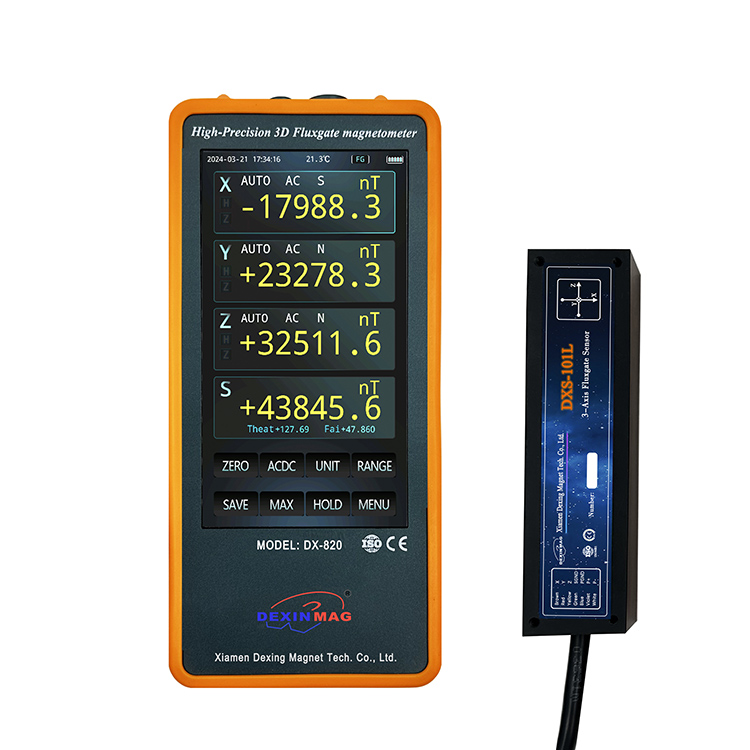
Handheld Triaxial Fluxgate Magnetometer
Overview
This Handheld Triaxial Fluxgate Magnetometer delivers an unprecedentedly efficient and accurate measurement experience of weak magnetic fields (nT level), providing reliable data support for scientific research and industrial testing. The DX-820 3D fluxgate magnetometer employs advanced fluxgate sensor technology, boasting extremely high sensitivity and unparalleled accuracy, easily capturing subtle changes in magnetic fields. Combined with professionally designed and optimized hardware circuitry, it perfectly unleashes the sensor's performance potential. The digital circuitry utilizes a high-performance ARM Cortex 32-bit microcontroller chip, featuring a high-performance, efficient memory architecture, faster response speed, and lower measurement latency.
The analog circuitry employs ULLASS ultra-low-loss sampling patented technology, achieving high-quality acquisition of weak signals. The ultra-high-definition large screen reproduces data details with exquisite colors, and its wide viewing angle is unaffected by strong light interference, ensuring clear visibility even in complex environments. The user-friendly interactive touch design makes operation smooth and convenient; a light touch allows for easy completion of various function settings and data retrieval, eliminating cumbersome buttons and providing a completely upgraded user experience. The product complies with international system certifications such as ISO9001, CE, and IQNET.
Features
|
Capacitive touchscreen with adjustable backlight |
AC/DC magnetic field measurement |
Orthogonality correction algorithm |
|
5 ¾-digit reading resolution |
Intelligent range switching |
FFT analysis |
|
Bilingual display (Chinese and English) |
Intelligent probe recognition |
High-speed/low-speed switching |
|
Measured values and curves displayed |
Spherical coordinate display |
Analog output |
|
Extreme/maximum value display and peak hold |
Ultra-low noise |
Threshold detection |
|
Data storage, callback, and export |
USB-C data communication |
General instruction set (supports LabVIEW) |
Technical parameters
|
Dimensions (Length × Width × Height) |
195 mm×90 mm×40mm |
|
|
Dimensions |
3 |
|
|
Display Units |
nT、μT、mGs |
|
|
Resolution |
0.1nT |
|
|
DC Range (Optional) |
±100μT |
±1000μT |
|
ACL Range (≤100Hz) |
±100μT |
±1000μT |
|
ACH Range (>100Hz) |
±50μT(RMS) |
±500μT(RMS) |
|
Temperature Coefficient of Error |
±1nT/℃ |
±10nT/℃ |
|
Accuracy |
DC: ≤0.5% RDG; AC: ≤1% RDG |
|
|
Host Bandwidth |
50kHz |
|
|
Response Frequency |
≤2kHz |
|
|
Sensor Noise |
10 to ≤20pTrms/√Hz at 1Hz |
|
|
Warm-up Time |
15-minute scaling capability |
|
|
3D Orthogonality Error |
<1° |
|
|
Hysteresis |
<2nT at 1 x full scale |
|
|
Operating Temperature Range |
-40℃ to +70℃ |
|
|
Storage Temperature Range |
-40℃ to +85℃ |
|
|
Probe Size |
24 mm × 24 mm × 109 mm |
Miniature: 20mm*20mm*20mm |
|
Communication |
TYPE-C |
|
|
Analog Output |
3-channel analog output port |
|
|
Supporting Software |
Data reading software |
|
General specification
|
Analog Interface |
BNC |
|
Communication Interface |
TYPE-C |
|
Display |
5-inch capacitive touchscreen, 720×1280 resolution |
|
Power Supply |
Built-in lithium battery |
|
Power Consumption |
4.2W |
|
Continuous Operation |
3.5 hours |
|
Adapter Probe |
3D fluxgate sensor DXS-101L |
|
Main Unit Weight |
362.8g |
Control interface
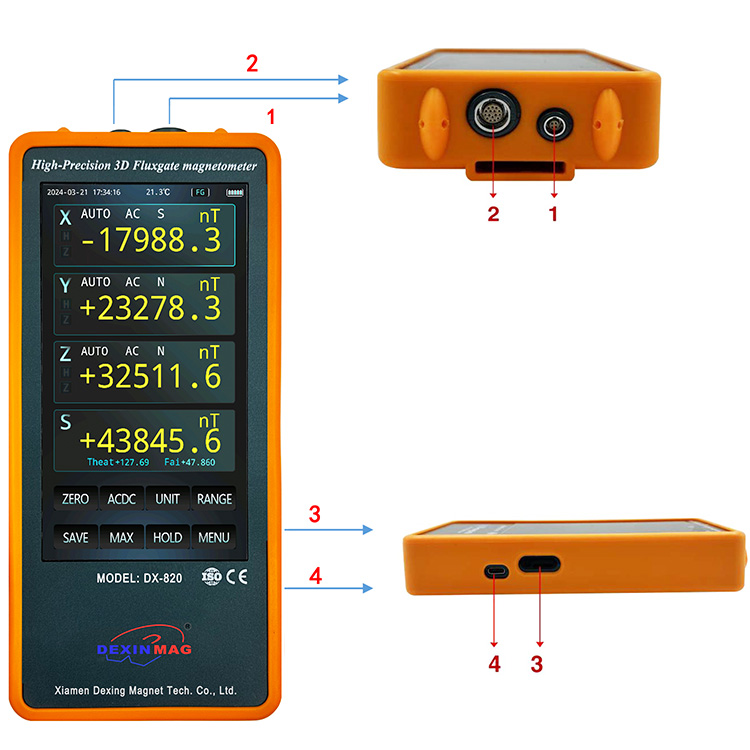
|
1 |
Analog signal output |
|
2 |
Sensor input |
|
3 |
Power on/off button |
|
4 |
Digital signal output/charging interface |
Adapt probe
Selectable measurement ranges are ±100μT and ±1000μT, with a frequency response of DC-2kHz, linearity of 0.01%, triaxial orthogonality error of less than 1°, and noise of <20pT rms/√Hz at 1Hz.
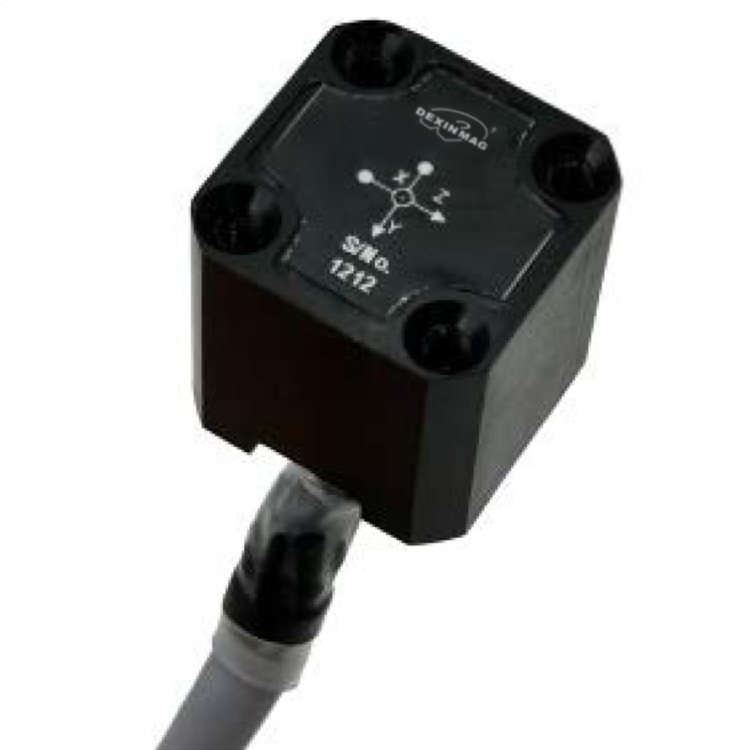
The miniature probe greatly reduces the size of the three-dimensional fluxgate probe to only 20*20*20mm, allowing it to be placed in confined spaces to measure magnetic fields.
Function Introduction
|
|
|
|
|
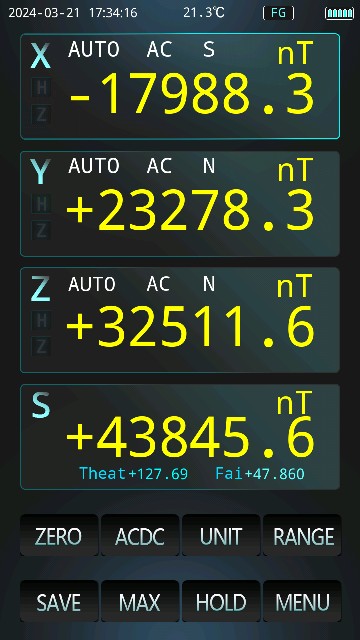
Magnetic Field Measurement
Touch buttons include: zeroing, AC/DC switching, unit switching, range switching, data saving, maximum and minimum value display, screen hold, and menu. |
Menu Settings
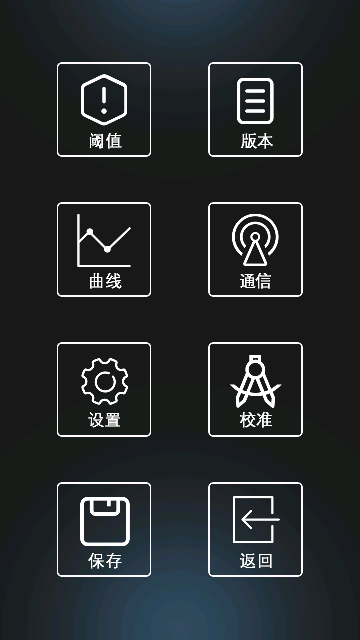
The menu interface includes threshold settings, version information viewing, curve viewing, communication settings, device settings, calibration, and save/view. The curve function includes time-domain plot display, peak detection, and FFT spectrum display. |
Threshold Settings
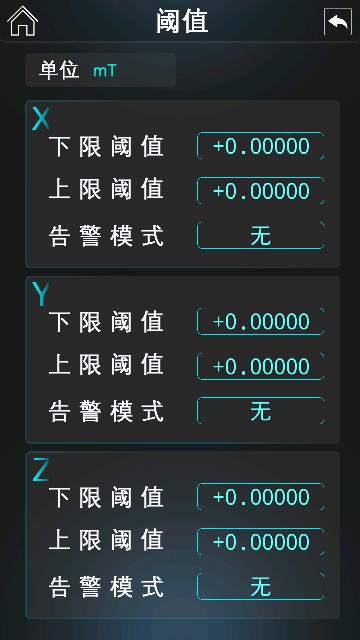
Threshold settings allow you to set three-dimensional alarm thresholds. When the collected value exceeds the set threshold, the device will issue an alarm. Units: mT, Gs. Threshold settings can be entered via numeric keypad. Alarm Modes: None, Within Range, Outside Range. |
|
|
|
|
|
Curve Display
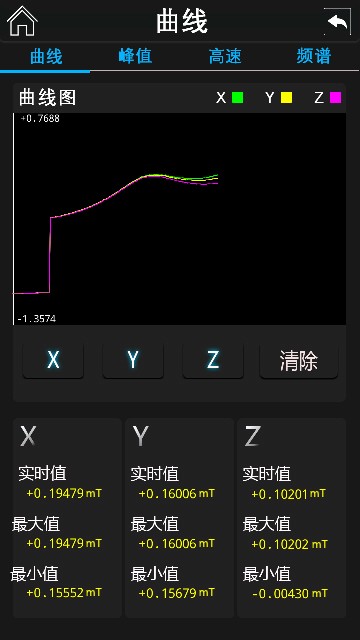
The curve displays a three-dimensional time-domain curve, and you can choose to display the curve for a specific axis individually. Below the curve, the current measurement value, maximum value, and minimum value are displayed. The FFT measurement frequency range is 0-2048Hz, displaying the magnitude and frequency of peak values. |
Device Settings
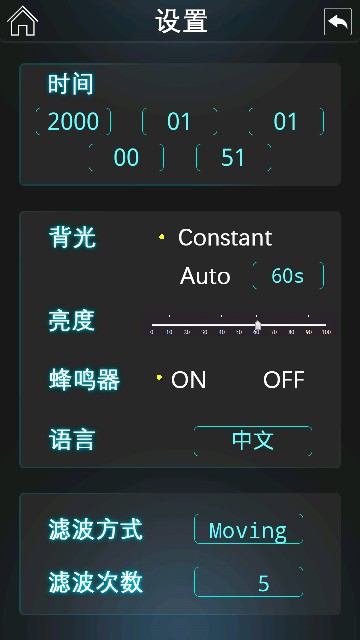
Time Settings: Set year, month, day, hour, and minute. Backlight Adjustment: Select between always on or automatic screen-off mode. Screen Brightness Adjustment. Buzzer On/Off. Language Settings. Filtering Method: Average Filter, Sliding Filter, None. |
Data Saving
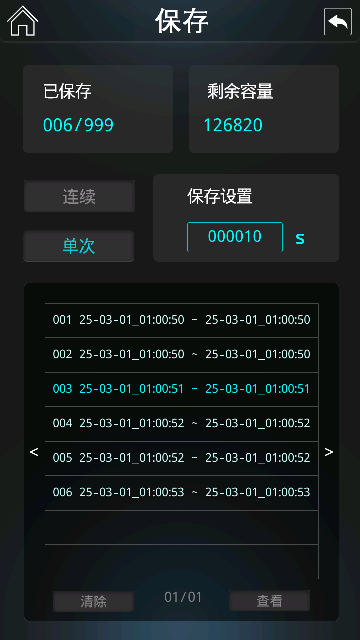
Saving Mode: Single or Continuous. Data Callback Viewing |
Data reading software
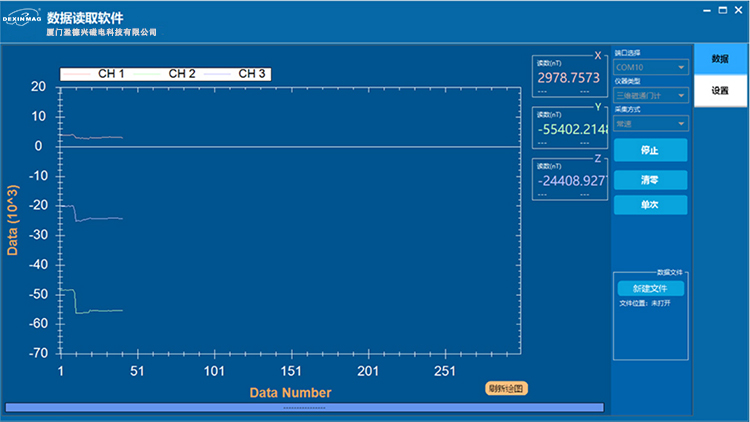
The host computer data reading software features recording and plotting functions, automatic probe calibration/host automatic memory operation mode, automatic zero point, automatic range, threshold setting and alarm, self-setting time and brightness, and display unit nanotesla, among many other intelligent functions.
(1) Users can use a computer to read test data and draw various measurement diagrams using professional supporting plotting software.
(2) Real-time data can be monitored on the computer using the serial port real-time transmission function.
(3) Real-time data can be queried using a fixed instruction set.
Applications
* Monitoring the Earth's environmental magnetic field, laboratory magnetic field, and space magnetic field;
* Calibrating laboratory magnetic field shielding and field sources;
* Detecting weak magnetic fields in rocks using drilling systems in geological exploration and petroleum systems;
* Detecting the attenuation characteristics and shielding effectiveness of magnetic field shielding systems;
* Detecting the magnetic shielding effect of magnetically shielded rooms;
* Dipole moment and remanent magnetic field of satellite equipment;
* Fluxgate meters; magnetoresistive magnetometers and calibration standards for various sensors;
* Earthquake precursor monitoring, volcano observation, and other environmental and disaster geological work;
* Airborne and marine magnetic surveys;
* Weak magnetic field research in biological sciences.